
Infrastructure and Extraction Technology
The infrastructure of the Mining Plant in Stargard relies on a unique system of seven geothermal wells – both vertical and directional ("J" type and "S" type). These boreholes reach depths from 2 660 to even 3 080 meters (with most hovering around 2 900 m).
Until 2017, the foundation of operational safety in Stargard geothermal was an advanced system of geothermal doublets, based on the close cooperation of production and injection wells GT-1 (serving as production) and GT-2 (serving as injection well). In this arrangement, every well drawing water has its counterpart in injection wells.
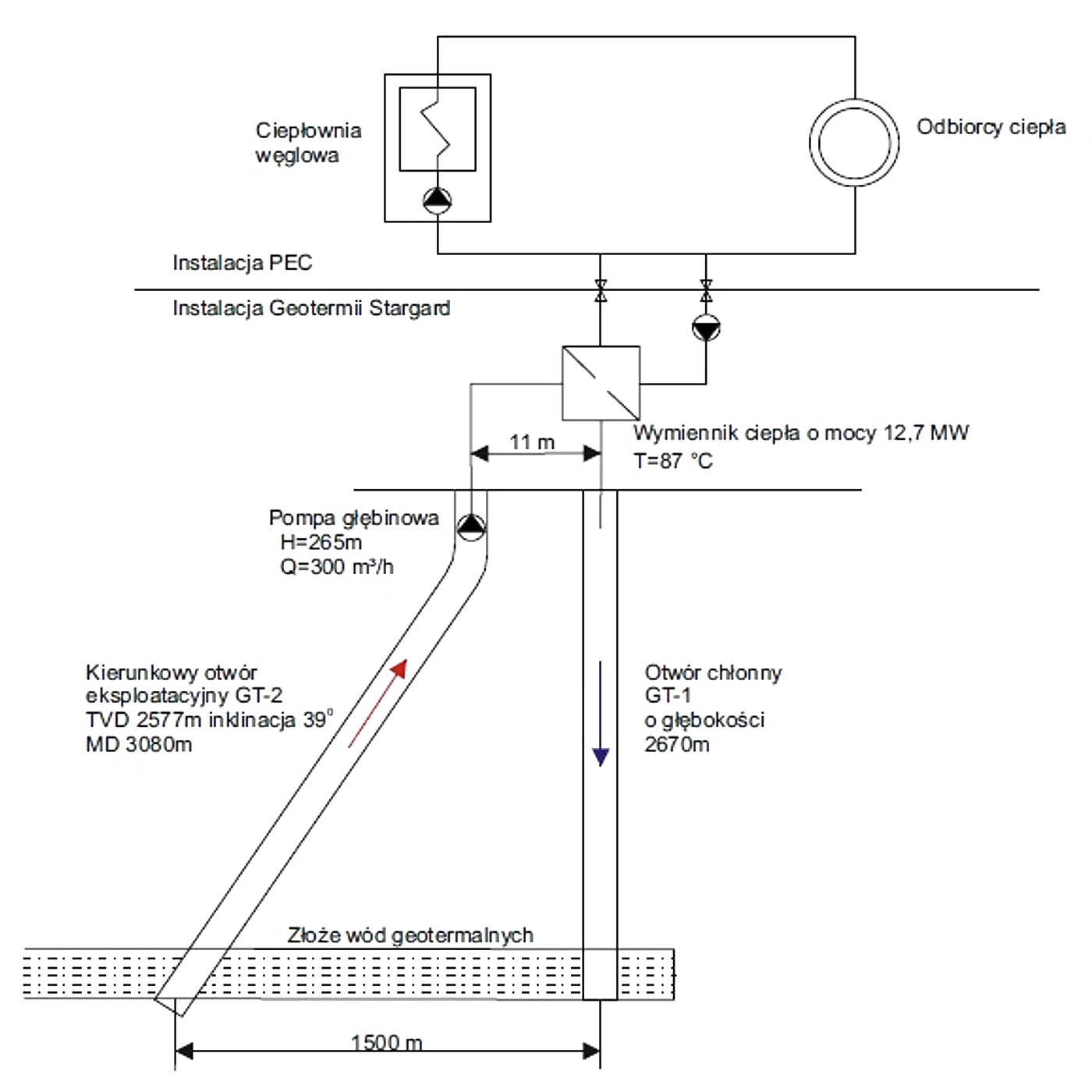
Since 2017, with the commissioning of the GT3 well, Stargard geothermal began moving away from traditional doublets in favor of a collector system unique on a national scale (this process was completed in 2020). Unlike standard doublets, this solution allows for full, dynamic control over brine flow. The process does not occur rigidly "from well to well", but in a flexible model that allows directing the medium from any production well to any injection well.
Hot brine, with a temperature reaching 90°C, is extracted from a depth of approx. 2.9 km through two production wells: GT6 and GT7. After releasing thermal energy in an advanced exchanger system, cooled water returns to the reservoir through any chosen configuration among the five injection wells (GT1, GT2, GT3, GT4, and GT5).
This innovative collector architecture is the key to installation safety and efficiency. It allows for precise management of pressure and injection efficiency, which, given the high salinity of local waters, is essential for maintaining the natural balance of the reservoir. Thanks to this, the system not only protects the aquifer but guarantees stable green energy supplies covering a significant part of the city's demand, which, translated into traditional fuels, avoids burning hundreds of coal wagons annually.
The final link in this process is transferring the recovered heat to the municipal PEC network in Stargard, from where ecological energy goes directly to residents, making the local heating system one of the most modern in Poland.